






Founded in 1776 by a group of five students at the College of William & Mary in Williamsburg, Virginia, The Phi Beta Kappa Society began as a secret fellowship devoted to scholarly exploration and the pursuit of wisdom. Guided by its motto, Φιλοσοφία Βίου Κυβερνήτης—“Love of learning is the guide of life”—the Society has, for nearly two and a half centuries, championed intellectual curiosity, critical thinking, and creative endeavor. It continues to recognize excellence across the liberal arts and sciences.
This year, the Society celebrates the 71st anniversary of the Phi Beta Kappa Book Awards in its founding city, as part of the launch of its 250th anniversary year in 2026. The three awards recognize outstanding nonfiction works that illuminate ideas and scholarship in the humanities, social sciences, natural sciences, and mathematics, reflecting the Society’s longstanding commitment to advancing knowledge and fostering meaningful public engagement.
Beginning in 1954 with what is now the Christian Gauss Award, Phi Beta Kappa has honored authors whose work exemplifies clarity, insight, and scholarly rigor. The ΦΒΚ Award in Science and the Ralph Waldo Emerson Award, introduced in 1960 and 1961, respectively, extended this tradition to celebrate contributions across disciplines. In keeping with this legacy, the Society is pleased to announce the 2025 winners, authors whose books reflect intellectual vitality and dedication to the values that have defined Phi Beta Kappa since its founding.
Winner of the 2025 Christian Gauss Award
Established in honor of Christian Gauss, an influential teacher, scholar, and president of Phi Beta Kappa, the award recognizes outstanding books of literary criticism, including biography.
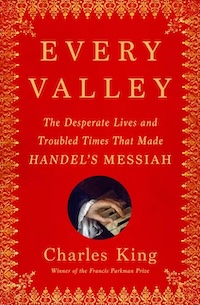
Every Valley: The Desperate Lives and Troubled Times That Made Handel’s Messiah
Charles King (ΦBK, University of Arkansas)
Doubleday, 2024. 252 pages.
From the publisher (Doubleday): George Frideric Handel’s Messiah is arguably the greatest piece of participatory art ever created. Adored by millions, it is performed each year by renowned choirs and orchestras, as well as by audiences singing along with the words on their cell phones.
But this work of triumphant joy was born in a worried age. Britain in the early Enlightenment was a place of astonishing creativity but also the seat of an empire mired in war, enslavement, and conflicts over everything from the legitimacy of government to the meaning of truth. Against this turbulent background, prize-winning author Charles King has crafted a cinematic drama of the troubled lives that shaped a masterpiece of hope.
Every Valley presents a depressive dissenter stirred to action by an ancient prophecy; an actress plagued by an abusive husband and public scorn; an Atlantic sea captain and penniless philanthropist; and an African Muslim man held captive in the American colonies and hatching a dangerous plan for getting back home. At center stage is Handel himself, composer to kings but, at midlife, in ill health and straining to keep an audience’s attention. Set amid royal intrigue, theater scandals, and political conspiracy, Every Valley is entertaining, inspiring, and unforgettable.
Winner of 2025 ΦΒΚ Award in Science
This award recognizes superior contributions by scientists to the literature of science.
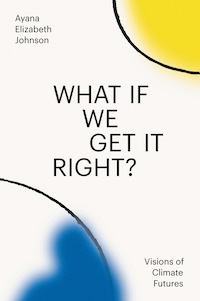
What If We Get It Right? Visions of Climate Futures
Ayana Elizabeth Johnson
One World, 2024. 496 pages.
From the publisher (One World): Sometimes the bravest thing we can do while facing an existential crisis is imagine life on the other side. This provocative and joyous book maps an inspiring landscape of possible climate futures.
Through clear-eyed essays and vibrant conversations, infused with data, poetry, and art, Ayana Elizabeth Johnson guides us through solutions and possibilities at the nexus of science, policy, culture, and justice. Visionary farmers and financiers, architects and advocates, help us conjure a flourishing future, one worth the effort it will take—from every one of us, with whatever we have to offer—to create.
If you haven’t yet been able to picture a transformed and replenished world—or to see yourself, your loved ones, and your community in it—this book is for you. If you haven’t yet found your role in shaping this new world or you’re not sure how we can actually get there, this book is for you.
With grace, humor, and humanity, Johnson invites readers to ask and answer this ultimate question together: What if we get it right?
Winner of the 2025 Ralph Waldo Emerson Award
This prize honors a scholarly study that contributes significantly to interpretations of the intellectual and cultural condition of humanity.
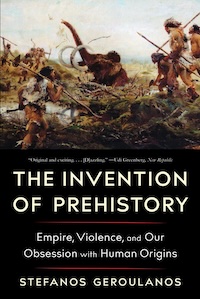
The Invention of Prehistory: Empire, Violence, and Our Obsession with Human Origins
Stefanos Geroulanos (ΦBK, Princeton University)
Liveright, 2024. 512 pages.
From the publisher (Liveright): Books about the origins of humanity dominate bestseller lists, while national newspapers present breathless accounts of new archaeological findings and speculate about what those findings tell us about our earliest ancestors. We are obsessed with prehistory—and, in this respect, our current era is no different from any other in the last three hundred years. In this coruscating work, acclaimed historian Stefanos Geroulanos demonstrates how claims about the earliest humans not only shaped Western intellectual culture but also gave rise to our modern world.
The very idea that there was a human past before recorded history only emerged with the Enlightenment, when European thinkers began to reject faith-based notions of humanity and history in favor of supposedly more empirical ideas about the world. From the “state of nature” and Romantic notions of virtuous German barbarians to theories about Neanderthals, killer apes, and a matriarchal paradise where women ruled, Geroulanos captures the sheer variety and strangeness of the ideas that animated many of the major thinkers of the eighteenth and nineteenth centuries, including Jean-Jacques Rousseau, Charles Darwin, and Karl Marx. Yet, as Geroulanos shows, such ideas became, for the most part, the ideological foundations of repressive regimes and globe-spanning empires. Deeming other peoples “savages” allowed for guilt-free violence against them; notions of “killer apes” who were our evolutionary predecessors made war seem natural. The emergence of modern science only accelerated the West’s imperialism. The Nazi obsession with race was rooted in archaeological claims about prehistoric IndoGermans; the idea that colonialized peoples could be “bombed back to the Stone Age” was made possible by the technology of flight and the anthropological idea that civilization advanced in stages.
As Geroulanos argues, accounts of prehistory tell us more about the moment when they are proposed than about the deep past—and if we hope to start improving our future, we would be better off setting aside the search for how it all started. A necessary, timely, indelible account of how the quest for understanding the origins of humanity became the handmaiden of war and empire, The Invention of Prehistory will forever change how we think about the deep past.
For more information on the Phi Beta Kappa Book Awards, please visit our Awards page pbk.org/awards or contact the Development, Events, & Awards Department at awards@pbk.org.