




FROM THE SECRETARY, SPRING 2026
One classic piece of advice has stayed with me since childhood: on any journey, especially a difficult one, go with a trusted friend. As Phi Beta Kappa continues along our quarter-millennium journey, we celebrate academic excellence, champion expertise, and defend academic freedom and free inquiry by working alongside trusted partners. Recent examples have brought the value of those partnerships into focus.
Phi Beta Kappa has worked closely with the American Association of Colleges and Universities (AAC&U) for many years. Our partnership has grown even stronger over the past decade, particularly since the Society’s former President, Lynn Pasquerella (ΦΒΚ, Mount Holyoke), became their leader. In January, members of the Phi Beta Kappa national office staff participated in the AAC&U’s annual meeting, exchanging ideas and program strategies with colleagues from across the country.
I spoke on a panel entitled “Collaboration as an Essential Strategy in Challenging Times” with the leaders of organizations including the American Council of Learned Societies, the American Historical Association, and the Modern Language Association. Together, we have advanced initiatives such as advocacy for the National Endowment for the Humanities and federal support for research and student financial aid. Partner institutions rarely share identical priorities, but shared core values enable us to work together effectively. By coordinating our efforts, we reinforce the centrality of academic freedom and expertise to our nation’s prosperity and national security.
In February, Lynn and I were asked by another longtime ΦΒΚ leader and former President, Peter Quimby (ΦΒΚ, Bowdoin), to address the 133rd meeting of the Heads and Principals Association, an annual gathering of public and private school leaders. We spoke of the academic and intellectual climate on college and university campuses today and about the challenges that our campuses are facing, especially concerning academic freedom, free expression, and the value of liberal arts and sciences education. I was particularly struck by a conversation with a head of school who remarked that she and other secondary school leaders tended to think of higher education almost in “market” terms, as if colleges and universities were the “consumers” to whom secondary schools must present their students seeking admission. Of course, there is something to that. But our program showed her something else—that high schools and colleges are also partners in a shared educational enterprise that must now demonstrate its value to a public, a significant part of which is skeptical. She, in turn, provided me with a powerful reminder that our allies are not only those who are engaged in higher education but those involved in education more broadly.
As Phi Beta Kappa and the nation celebrate 250 years, we do well to recall that the ringing assertion in our founding documents that governments derive their just power from the consent of the governed requires an informed consent, which requires an educated public. That education does not start in college. Supporting the arts and sciences from the earliest years is essential to preparing citizens capable of critical thinking, informed judgment, and meaningful participation in democracy.
A third example of partnership is an opinion essay that I co-authored with the president of Skidmore College, Marc C. Conner (ΦΒΚ, University of Washington), published in the Albany Times-Union in February. This essay grew from discussions of recent events in Minneapolis and their implications for the mission and values of higher education. Colleges and scholarly societies should generally remain neutral on matters of public debate, but we should speak out when events threaten the core mission of our institutions.
As we wrote, higher education prepares students for life after college: for meaningful work, for contributing to society, and for leadership in civic life. It equips students to champion and defend the fundamental principles of the American republic. The alarming actions in Minneapolis, including violence against peaceful assembly, intimidation of citizens, and denial of the rule of law, threaten not only the foundation of learning but also the foundation of the nation itself. Such actions open the door to oppression and unchecked authority.
Let me be clear. This essay was neither criticism along partisan lines nor a stance on complex political issues. As we acknowledged, “we weren’t on the streets of Minneapolis to know exactly what happened. We recognize that the questions of migration and citizenship are complicated and that there are many different views in our country on those questions.” We are not making a political argument about those questions. We are affirming “the vital importance of the rule of law and the imperative of peaceful demonstration and discussion.” Our purpose was to place education at the center of those principles.
For 250 years, Phi Beta Kappa has sought out trusted and thoughtful partners as we confront the issues of our time. These partnerships sustain us in our journey. There is no more suitable way to celebrate the nation’s semi-quincentennial and our own.
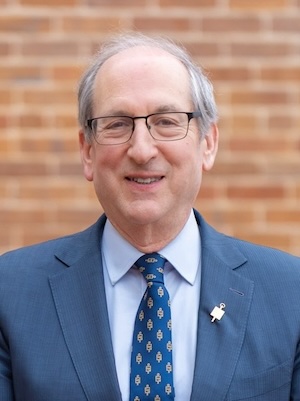
Frederick M. Lawrence
Secretary and CEO
Secretary Lawrence has spoken nationally and internationally on free expression, academic freedom, and the importance of liberal arts and sciences education. This fall he delivered a keynote address on the challenges facing higher education at the annual meeting of Universities UK, the institution representing all British universities. Over the past months, he spoke at the University of Ljubljana, Slovenia, the Hertie School in Berlin and Università Cá Foscari Venezia in Venice. He has addressed the American Association of Colleges and Universities, the American Council on Education, and the annual Higher Education Law & Policy conference. He has appeared on PBS NewsHour, CNN, and CBC. In addition to his role at the Society, Secretary Lawrence is a distinguished lecturer at the Georgetown University Law Center, where he teaches “Free Speech on Campus” and “Higher Education and the Law.” He is the author of numerous articles on the topics of free expression, free inquiry, and academic freedom, and he is a co-author of the forthcoming 3rd edition of Higher Education and the Law, the leading casebook in the field.