






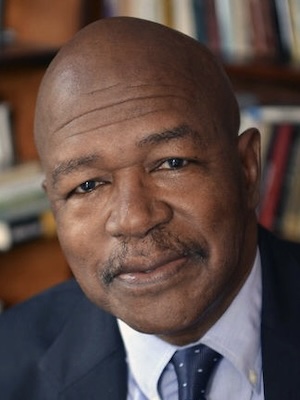
In April, Elijah Anderson, Sterling Professor of Sociology and of Black Studies at Yale University, visited Bowdoin College as part of the Phi Beta Kappa Visiting Scholar Program. Widely regarded as one of the foremost urban ethnographers and cultural theorists in the United States, Anderson is also a Stockholm Prize laureate for his pioneering research in the field of criminology.
As a ΦBK Visiting Scholar, Anderson also spent two days at each of the following campuses, hosted by their respective ΦBK chapters: Cornell College, St. Mary’s College of Maryland, Hamline University, Butler University, Davidson College, Morehouse College, and Spelman College.
A hallmark of the Visiting Scholar Program is the public lecture, designed to foster intellectual exchange both on campus and within the broader community. Anderson’s lecture, “The Cosmopolitan Canopy: Race and Civility in Everyday Life,” drew from his influential 2011 book of the same title. In it, Anderson develops the concept of the “cosmopolitan canopy” as a metaphor for civil society: shared public spaces in which norms of civility and mutual recognition create opportunities for meaningful interracial interaction within otherwise segregated social environments.
The evening’s lecture was enriched by the participation of Kevin “KAYR” Robinson (Bowdoin ’05), whom Anderson first met while mentoring at-risk youth in Philadelphia. Robinson, who appeared in one of Anderson’s early ethnographic studies, reflected on the enduring impact of Anderson’s mentorship and described the relationship between Anderson’s scholarship and his lived experience as “theory” and “practice.”
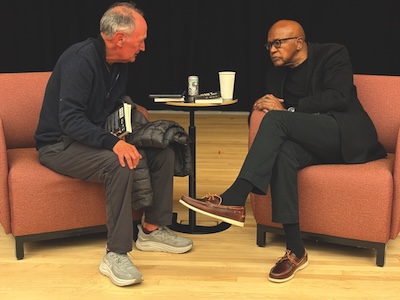
College, at the public lecture for the Visiting Scholar Program on campus.
The impact of Anderson’s visit resonated deeply across the Bowdoin community, including Bowdoin’s ΦBK Chapter President Krista Van Vleet: “Professor Anderson shared so generously with us on his visit to Bowdoin. Faculty members and students especially enjoyed talking with him in the two classes he visited. In conversations with students, he reflected on his personal experiences as well as his scholarship, really deepening and bringing to life the history of civil rights, urban social change, and civility in the United States and giving students ways to think about the contemporary moment.”
Anderson likewise praised the intellectual engagement of Bowdoin students. “My visit to Bowdoin was an incredibly enriching academic experience,” he said. “I had the privilege of interacting with many exceptional and wise undergraduates. Many of them posed thought-provoking questions and were eager to learn from my urban ethnographic work. They expressed a genuine passion for learning and the knowledge I shared with them.”
Van Vleet also emphasized the broader significance of the ΦBK Visiting Scholar Program itself: “The Program has such a positive impact on the intellectual life and interdisciplinary dialogue of our small liberal arts campus. Eminent scholars like Professor Anderson interact with students and faculty across multiple disciplines and, frequently, with those who are not associated with Phi Beta Kappa. People in the Midcoast Maine area as well as the Maine Association of ΦBK also attend the public lecture. Truly a great program that meaningfully broadens and deepens understanding of an array of topics and issues.”
Anderson’s visit demonstrates the distinctive value of the Phi Beta Kappa Visiting Scholar Program in creating spaces for the exchange of ideas and reflection, which is precisely the kind of dialogue envisioned in Anderson’s conception of the cosmopolitan canopy itself.
By Hadley Kelly, Senior Director, Academic Outreach & Programs