




At the center of today’s higher education debates is the collapse of public trust in colleges and universities. Why has confidence fallen, and how can higher education restore it? Phi Beta Kappa has a unique role in answering these questions in our semi-quincentennial year as we commemorate the ideals that inspired our start in 1776.
The 2026 Malcolm Lester lectures provided a welcome opportunity for me to explore and discuss the public perceptions of higher education. These lectures hold a deep connection to Phi Beta Kappa, as my predecessor John Churchill delivered the inaugural series in 2018. Let me share key aspects of my argument in “The Brilliant Arc of America’s Most Treasured Resource: Higher Education and American Democracy.”
First, the familiar claim that support for American higher education is “plummeting” oversimplifies a more complex reality. The concern is real: a 2025 Pew Research study found that 70% of Americans believe higher education is heading in the wrong direction, compared with just 28% who say it is on the right track. A decade earlier, Gallup reported a very different picture: 60% of Americans expressed “great confidence” in higher education, with another 30% expressing some confidence.
Yet when people answer more specific questions, a more nuanced picture emerges. The 2025 American Higher Education Barometer shows that Americans view higher education as essential to science (90%), democracy (72%), and health care (83%), among other areas. Opposition to federal cuts far exceeds support for these cuts across key areas, including science funding, where it stands at four to one; health research, where opposition is five times higher than support; and higher education overall, also at four to one. This broader pattern suggests a path forward for rebuilding public trust.
Second, the case for higher education rests on a simple core principle. Colleges and universities exist to serve the broader public good through teaching, research, and service to their communities and the nation. Even academic freedom, often seen as campus-centered, ultimately advances the public good. Economic theory helps clarify why: academic freedom corrects a market failure that would otherwise underproduce expertise. In that sense, robust academic freedom enables universities to drive human progress and innovation.
Third, higher education institutions must accept responsibility for some of the public distrust and reassert their historic mission. As Phi Beta Kappa articulated in “Higher Education’s Compact with America: Shared Principles for the Common Good,” issued jointly by the American Association of Colleges and Universities, we must commit ourselves to affordability, intellectual openness and diversity of opinion, academic excellence, and partnerships with government, industry, and communities.
“Higher Education’s Compact with America” makes one point clear: the case for higher education depends on strengthening its mission, not shrinking it. Some argue universities should strip civic engagement and democratic commitment from that mission. Phi Beta Kappa has never taken that view. From our earliest days nearly 250 years ago, we embraced three values on campus and in community life, symbolized by the stars on our key: literature, morality, and friendship. Those values now guide how we apply learning to the challenges of our own time. For Phi Beta Kappa, knowledge inspires action, both in the best and darkest moments.
This commitment is powerfully illustrated by our advocacy for arts and sciences education and by the ways in which we are celebrating our 250th anniversary. This spring on the West Coast, in San Diego, we launched our national events series with “The Human Algorithm,” an exploration of the challenging relationship between AI and the arts and sciences. Future programs will be held in Chicago (September 29), Atlanta (March 31), and Houston (May 18). Full details are available on our website.
I close this column on a bittersweet note, as this issue of The Key Reporter is the final one edited by Kelly Gerald. For more than two decades, Kelly has shepherded over 80 issues of the Reporter, providing a source of information and delight to our members through articles, profiles, and book reviews. We are grateful to Kelly for her years of service to Phi Beta Kappa and to our membership and wish her well on the next stage of her journey. She has left a legacy through her impact on these pages, and she will be missed by her colleagues in the national ΦΒΚ office and I know by you, our members and loyal readers.
Join us as we celebrate our semi-quincentennial. And please mark your calendar for the grand celebration of the actual 250th anniversary at our Gala in Washington, D.C.’s historic Smithsonian National Postal Museum on December 5, 2026. I look forward to seeing you there!
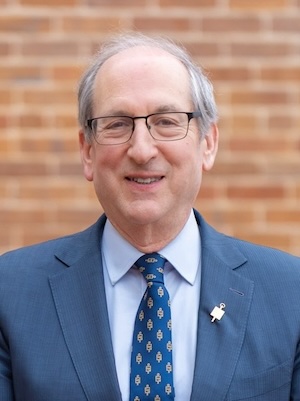
Frederick M. Lawrence
Secretary and CEO
Secretary Lawrence has spoken nationally and internationally on free expression, academic freedom, and the importance of liberal arts and sciences education. This spring he spoke on the state of American higher education at University College London, as part of its 200th anniversary program series. He has spoken recently at the European Court of Human Rights, the University of Ljubljana, Slovenia, the Hertie School in Berlin, and Università Cá Foscari Venezia in Venice. This spring, Secretary Lawrence delivered the 9th annual Malcolm Lester Lectures at Mercer University and spoke at the annual Higher Education Law & Policy conference. He has addressed the American Association of Colleges and Universities, the American Council on Education, and has appeared on PBS NewsHour, CNN, and CBC. In addition to his role at the Society, Secretary Lawrence is a distinguished lecturer at the Georgetown University Law Center, where he teaches “Free Speech on Campus” and “Higher Education and the Law.” He is the author of numerous articles on the topics of free expression, free inquiry, and academic freedom, and he is a co-author of the forthcoming 3rd edition of Higher Education and the Law, the leading casebook in the field.