



By Alia Yee Noll
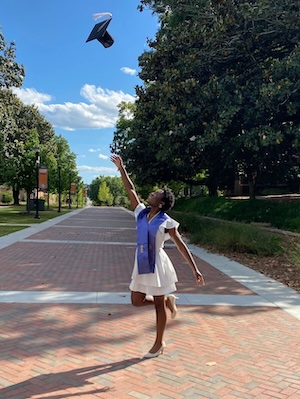
For Esther Adewumi (ΦBK, Mercer University), her passion for scientific research began with her love of art.
Growing up, Adewumi loved crocheting, drawing, and singing. She sees scientific discovery as similarly creative: the field requires innovative problem-solving and has lasting, visible impacts.
“I noticed that science was an avenue for helping people and producing something tangible that could last,” Adewumi said. “If I can make something that is the matter of somebody living even five more years than they would have otherwise, that is amazing.”
Adewumi, who graduated in 2025 with a Bachelor of Science in biochemistry and molecular biology and a minor in Spanish, recently began the prestigious DIRECT Fellowship at the Duke Cancer Institute. The yearlong program prepares recent graduates for a career in cancer research.
Now based in Durham, North Carolina, Adewumi works in cancer epidemiology research under Dr. Tomi Akinyemiju, focusing on global cancer disparities. In Duke’s REGAL lab, Adewumi is examining risk factors for breast cancer across international cohorts, including participants in Nigeria, Ghana, The Gambia, and the United States. A key focus is triple-negative breast cancer, which disproportionately affects people of African descent.
While Adewumi’s undergraduate classes focused on biochemistry and molecular biology, Mercer’s Stamps Scholars Program gave her several opportunities to study abroad. These programs took her to Europe and the Middle East, where she learned more about health disparities in marginalized communities and provided basic emergency response training.
“I didn’t know it at the time, but that was where the seed was planted to look beyond the microscope at how all the things that we do in hard science research are applied and implemented in people’s everyday lives,” Adewumi said. “Not everybody gets the same or equal treatment, and not everybody responds to the treatment in the same way.”
She also studied in Spain for a month to build up her Spanish fluency, which she plans to continue improving in Durham to support its growing Venezuelan population.
“Durham definitely does have a huge Hispanic population, so I am trying to get plugged in by getting acquainted with people in that space,” Adewumi said. “I went to a symposium the other day and got in contact with the breast lactation group specifically for Latinas, and hopefully, I can attend those events and volunteer with them.”
During the fellowship, Adewumi hopes to publish her research findings and present at conferences. Looking ahead, she plans to earn her PhD and continue doing research, potentially in biomedical engineering, public health, or molecular epidemiology.
“We all are constantly learning. That’s why I chose a career in research,” Adewumi said. “You’re supported to pursue those questions that you really want to get answered.”
She also wants to give back to the scientific research community, passing on what she’s learned and encouraging diversity in the field.
“I definitely want to continue to invest in many others, especially those who might feel like they don’t fit in science,” Adewumi said. “Growing up, my picture of a scientist was a lackluster person in a lab coat toiling over a bench all by themselves. Since entering the research world, I learned that is not at all what science looks like. Scientists work in teams. They encourage diversity of ethnic backgrounds, academic expertise, and ways of thinking. It’s a much more lively world than I imagined!”
Aside from “wonderful friends and awesome mentors,” Adewumi’s hands-on experiences abroad truly shaped her career path and allowed her to explore different curiosities.
“Being able to go out into the world was something that expanded my worldview and showed me different walks of life that I didn’t know about before, different problems I could solve, different people I could advocate for,” Adewumi said.
Between her love for research, creative endeavors, and direct engagement with health disparities, Adewumi will continue pursuing meaningful questions and following them wherever they lead.
“When I look at all the innovations in science and medicine, it all came from people thinking outside of the box and then mastering concepts in their field to the extent where they could take all of those pieces and put them together in a new way,” Adewumi said. “That’s basically art. That’s what I’m doing when I’m crocheting and looping the hook through the yarn, or when I put my pencil to the paper. I am putting a lot of different small pieces together in such a way that it’s something meaningful. That’s the kind of legacy I want to leave.”
Alia Yee Noll is a senior at the University of Southern California studying journalism with minors in documentary film and gender studies. She was inducted into Phi Beta Kappa there in April 2025. USC is home to the Epsilon of California chapter of Phi Beta Kappa.