






Shortlisted for ΦBK’s 2025 Christian Gauss Award
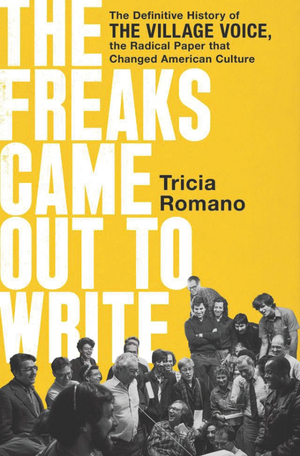
For nearly 70 years, the Village Voice has dished out acclaim, disdain, outrage, and on-the-ground reporting—whatever the New York City paper considered news, whether or not it was fit to print. Aptly, The Freaks Came Out to Write, Tricia Romano’s oral history of the Voice, is a raucous symphony of reporters’ recollections.
“Our philosophy was that you do not hire an expert; you hire someone who is living through the phenomenon worth covering,” explains Voice editor Richard Goldstein on the book’s first page. “The real ethos (was) that you were actually living what your byline was about.”
That explains a great deal: how each new issue of the Voice could be counted on to denounce someone readers had heard of, praise someone they hadn’t, fire off doubtful charges (was Columbia University really New York’s worst landlord?), and salt headlines with four-letter words.
“In an oral history, a person’s story is the story,” Romano writes. Among Voice veterans, recollections differ. Lenny Bruce is championed by Nat Hentoff and badmouthed by Jules Feiffer. Susan Brownmiller sets the record straight about dance critic Jill Johnston: “Somebody has recently claimed that she was the first feminist at the Voice, but I don’t see that. She may have been the first lesbian at the Voice.” The paper also struggled, in every sense, to hire Black writers and editors. Legendarily, even the janitors at the Voice were all white, with one exception—a young James Earl Jones.
Romano draws on more than 200 interviews. The 88 chapters are smartly edited, short, and focused, featuring such names as “We were the hippie generation,” “We started writing what they called the New Journalism,” “There’s some sort of music coming out of the Bronx called rap,” and “Certain deaths hit really hard.” The longest chapter, “We were filled with grief,” deals with the paper’s long-running civil war over how to cover the AIDS epidemic. The next-longest, “The music section was suddenly in flower,” revisits the 1980s music scene, quoting Debbie Harry and drummer Max Weinberg, who found his job with the E Street Band through a Voice classified.
If the Voice’s outlook might be anticipated, the paper was never wholly predictable behind the scenes. During the most volatile months of the ’60s, a college dropout named Don McNeill wrote memorably for the Voice about East Village hippies, bums, drugs, and protests. In midsummer 1968, aged 23, McNeill visited a new friend upstate. Sex and drugs intervened, and McNeill walked into a lake fully clothed and drowned.
Accident or suicide? Goldstein sees a straight line of causality: “That sequence, the acid, the gay experience, the drowning … it was hard to believe he didn’t do that deliberately.” Jim Fouratt, a Voice writer and gay rights activist, resists that judgment. Then a third writer weighs in. As McNeill’s former roommate, he offers nuance rather than certainty—but the real surprise here is the speaker’s identity: novelist Lucian K. Truscott IV, West Point class of 1969, son and grandson of U.S. Army commanders, direct descendant of Thomas Jefferson, and the Voice reporter who covered the Stonewall riots of June 1969.
Romano traces links between the bohemian rag and the New York establishment. The Voice’s origins lie in the Second World War: Norman Mailer funded its first issues out of his profits from The Naked and the Dead. Co-founder and editor Dan Wolf hired communications royalty, including Sally Kempton—the daughter of legendary newsman Murray Kempton—and Paul Cowan, son of CBS television network president Louis G. Cowan. During a stint in the New York City Parks Department, editor Mary Perot Nichols helped to thwart city planner Robert Moses’s proposed projects. Once, the Voice even assigned a book review to real-estate magnate Donald Trump. (Trump accepted the assignment but never turned in his copy.)
During the Great Recession, the paper was battered by cutbacks, firings, and changes of ownership. A 2017 staff reunion was held after the deaths of veteran muckraker Wayne Barrett and Nat Hentoff, a fierce proponent of civil liberties and jazz. Ironically, as Romano laments, this became “the funeral for the print edition. … The next year, the Voice closed for good. Or so we thought.”
Romano writes that the Voice’s current incarnation, primarily online, “if you don’t look at it too closely … somewhat resembles its old self, the one that had the city in its grip.” The website currently features an ominous record of “Contributors Emeritus (an incomplete and ongoing list).” But the book’s outlook is never mournful. Certain comments resonate, sardonic but hopeful, from a former editor-in-chief’s judgment—“so many people have tried to ruin the Village Voice, and many of them have succeeded”—to a stray remark from a freelancer, quoting a rock music critic: “All of us would probably agree 50 percent of the Voice was excellent and 50 percent was awful. We just couldn’t agree on which 50 percent.”
Allen D. Boyer (ΦBK, Vanderbilt University) lives and writes on Staten Island.