





By Alia Yee Noll
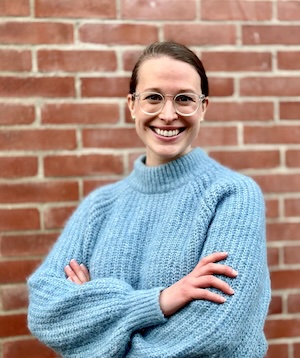
Caroline Culp (ΦBK, Wake Forest University) first honed her art curation skills as an undergrad on Wake Forest’s annual student-led art buying trip.
“That experience was really foundational for me in understanding the wider picture of the art world and experiencing it,” Culp said. “We went from within the classroom talking in hypotheticals, to engaging with the real world and understanding new things by applying the knowledge we’d learned in the classroom.”
She recalls her senior year spring break, which she spent exploring galleries across New York City, finding new pieces to join Wake Forest’s permanent collection. Her liberal arts background shone as she researched contemporary artists, negotiated with gallerists, and discussed potential purchases with her classmates.
“We had to come to conclusions by putting together an argument that is straightforward, convincing, and cogent and then winning your peers over to get your work of art confirmed,” Culp said. “That grows really naturally out of a liberal arts education, putting together an argument or a story that can excite people and really win a case.”
Culp went on to earn her PhD in art history at Stanford University. Now, as the Brock curator of American art at the Chrysler Museum of Art in Norfolk, Virginia, Culp will draw on the same liberal arts principles.
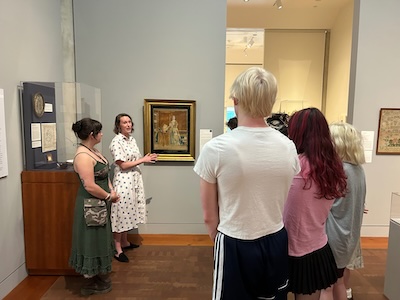
One of her primary projects is reinstalling the Chrysler’s vast collection of American art created before 1945, which she hopes to reimagine through cross-cultural themes that reveal “distinct narratives about the collection and about the history of the United States through art.”
“I’m thinking about ways that we can create interesting dialogues between these different histories. What connects humanity across time periods? How has that shifted radically across the course of human experience?” Culp said. “Answering these questions with objects in galleries can be very compelling for visitors. That’s why we go to our museums, to think and to experience with our eyes and bodies these objects from the past or present that challenge us and enlighten us.”
Culp grew up visiting her grandmother in Maryland in what she describes as a “big, rambly house full of old things,” surrounded by creativity—her mom is a geologist-turned-landscape artist, and her aunt works as a muralist and scientific illustrator. Her grandmother collected early American antiques and decorative arts.
“I was really taught as a young girl to appreciate history and craft and the stories and power that reside in objects,” Culp said.
She still treasures the artworks from her grandmother’s collection, including a portrait of a naval captain that was passed down from her great-grandmother. The work influenced her PhD dissertation on American portraitist John Singleton Copley and how the physical presence of portraits in the home suggests a kind of ghostly animacy to viewers. During her research, Culp noticed that people often saw the portraits in their homes as lively or animated.
“Why do we, as enlightened humans, see animacy in inanimate objects? I’m still fascinated by that,” Culp said. “We are human beings, and so much of our behavior is actually irrational, fundamentally, but we choose not to see it that way. Just one small aspect of this is the way that we treat objects and works of art.”
While writing her dissertation, Culp also reevaluated the role of the naval captain’s portrait in her own life, watching over her family as they celebrated birthdays and holidays in the dining room.
“I do think that his presence, the presence of this portrait, shifted the energy of the room. He made the room more formal. He lent an air of gravity to the occasions that happened in that space,” Culp said. “The object isn’t worth that much. It certainly needs some conservation, but it shifted the way that I experienced the world.”
At Wake Forest, Culp originally wanted to study history. She remembers learning about Paul Revere’s midnight ride in elementary school, piquing her interest in revolutionary history. Culp considered going to law school to become an attorney, but as an intern at the Reynolda House Museum of American Art, Culp quickly realized how art “navigates and intersects with American culture.”
Culp cited Wake Forest’s motto, Pro Humanitate, or “For Humanity,” as another driving force in her work. When she curates an exhibit, she wants to give back to the community in some way.
“There is this teaching at Wake that you should always be doing projects for the betterment of all people, of all humanity,” Culp said. “I feel like that impulse toward civic good is very much ingrained in my DNA at this point.”
As a curator, Culp also considers accessibility in its many forms, ranging from physical access to art inclusivity. Her approach reflects the values of her liberal arts education and Phi Beta Kappa membership, as the motto “Love of learning is the guide of life” continues to inform her commitment to inquiry and engagement. Whether she is writing exhibit labels or arranging the display cases within the gallery, Culp is always thinking about how the art will be interpreted by museumgoers.
“We want more diversity, both in terms of skin tones and nationalities, backgrounds. We want to represent both formally trained artists and self-taught artists,” Culp said. “With every new show that I work on, with every new article or book that I write, I’m always learning. There are so many millions of artists in the world and in history that are just waiting to have their stories told or told anew.”
Alia Yee Noll is a senior at the University of Southern California studying journalism with minors in documentary film and gender studies. She was inducted into Phi Beta Kappa there in April 2025. USC is home to the Epsilon of California chapter of Phi Beta Kappa.