






Behind every consequential policy decision is someone capable of turning ideas into action. For Phi Beta Kappa members on Capitol Hill, that work is grounded in an arts and sciences education that equips them to ask better questions, weigh competing perspectives, and navigate complex challenges.
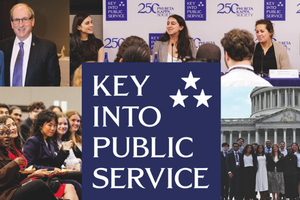
This summer, Phi Beta Kappa brought those experiences directly to the next generation of congressional professionals with generous support from the Gray Foundation. The Society’s Call to Serve networking event, part of our 2026 Key Into Public Service Conference, shared practical tips for interns, recent graduates, and young professionals looking to enter or advance in congressional careers. U.S. Congressman Dave Min (ΦBK, University of Pennsylvania) sponsored the event and welcomed the standing-room-only audience. He also reflected on the significance of that mission to the American story: “I am immensely proud to stand with you as a member of Phi Beta Kappa who believes fervently in the mission of the Society,” he said, “and I would proffer to you that these principles [championing education in the arts and sciences, fostering free thought, and recognizing academic excellence] are not only an intrinsic good in and of themselves but have served as the foundation of American exceptionalism over the past 250 years.”
Moderated by Los Angeles Times Washington correspondent Justine McDaniel (ΦΒΚ, University of Puget Sound), the panel featured advice from Monique Bolsajian (ΦΒΚ, University of California Santa Barbara), deputy chief of staff and legislative director for the Office of Gil Cisneros; Quinn Hirsch (ΦΒΚ, American University), senior policy advisor for the Office of Steny Hoyer; and Niko Malhotra (ΦBK, Williams College), a professional staff member for Chair Joni Ernst on the U.S. Senate Committee on Small Business and Entrepreneurship.
With degrees in literature, international affairs, public health, and economics, no two panelists followed the same path to Congress. Yet each described how their arts and sciences education prepared them to navigate careers defined by constant learning, fast-moving opportunities, and increasingly complicated policy challenges. The panelists offered students an insider’s guide to public service, from landing a first role on Capitol Hill and building policy expertise to pursuing graduate education, leading teams, and preparing for the next chapter of a career in service. Watch the panel and find additional resources for arts and sciences majors interested in local, state, or federal government careers from our 2026 Key Into Public Service Conference at pbk.org/KeyIntoPublicService2026.
You can also play an important role in bringing the knowledge and perspectives of the arts and sciences to major decisions shaping our nation’s future. In December 2026, the Society will unveil a new advocacy toolkit championing the value of the arts and sciences for our milestone 250th anniversary. Email advocacy@pbk.org to receive early access to the toolkit and learn how to put your support for the arts and sciences into action.
By Anne Tria Wise, Senior Director, Policy & Advocacy, and Delainey Boyd-Whaley, Deputy Director, Policy & Advocacy