






By Robert Pellenbarg
Shortlisted for ΦBK’s 2025 Award in Science
Ponder your memory for a moment. You may not take notes . . . Specifically, address the following:
What was your first car, and what did you like/dislike about it?
Describe your first romantic crush as a newly dating teen.
Explore your memories of your first semester at college.
As you examine the list, you will notice that some answers will be short and to the point; other answers will require a narrative. Further, ponder these scenarios added to the mix:
The questions are posed via a “quiz” delivered as text only by email. You answer via an email text message.
The questions arrive via email, but the first displays a picture of a generic car, the second has a cartoon of two lips and a heart-shaped balloon enclosing the word “smooch,” and the third shows the back of someone entering a rather disheveled dorm room. You answer via text.
Lastly, you are in an interview situation where a researcher asks you the questions verbatim. You respond verbally but feel a sense of “encouragement” to respond quickly and succinctly.
Importantly, consider two further possibilities for each query. First, you have a max of 10 minutes to respond. Second, you may take your time, up to 30 minutes, to gather and organize thoughts. Again, in all cases, no notes are to be produced.
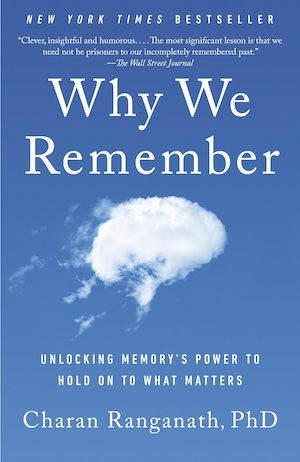
Clearly, your answers will be vastly different in the above situations. Why is this so? Why do we remember more or less detail depending on the context of the question? The author, Charan Ranganath, explores this reality in detail and helps the reader tease out the nature of memory. His explanations are based on decades of focused research, and he carefully explains how this research has matured, especially recently, with newly available technology. Indeed, this reality is the power of why we remember. It has become increasingly clear that memory drives curiosity, which drives memory, which supports survival.
As Ranganath explains and emphasizes, research on memory requires the ability to quantify memory. A pioneer in this regard was the late-nineteenth-century German psychologist Hermann Ebbinghaus. Ebbinghaus devised vast lists of “trigrams,” three-letter constructs in the order of consonant-vowel-consonant (e.g., DOG, KUZ, TYW). He would memorize these lists as well as possible and recite the list from memory. Crucially, he could score himself on what proportion of a list he could recite. These proportions were quantifiable data on memory, a research breakthrough for the time. He could clearly examine the effects of fatigue, hunger (generating a clear distraction), noise, and so forth. But there was as yet no hint as to what caused variability in the observed memory results.
Fast forward, and Ranganath leads the reader into fields such as details of brain anatomy teased out over decades of physical examinations, documented explorations of what happens as a result of focused surgery on the brain (e.g., lobotomies to cure epilepsy), and the ultimate breakthrough technique of using magnetic resonance imaging (MRI) to study in real time what happens in the brain when test subjects answer questions related to their memory of carefully crafted questions of events past, present, and, amazingly, future (hint: chess).
Student volunteers at various universities participated in studies utilizing MRI technology. Results showed clearly that if one part of the brain responds to a question, within seconds a different part of the brain will be enlisted to amplify a reaction, to provide new detail, to examine memory of a situation, and so forth. Such results show that memory is related to “handshakes” between such structures as the hippocampus, the amygdala, the prefrontal cortex, and so forth. Of critical import in this regard is the fact that the amygdala releases dopamine under certain conditions, which, depending on context, can enhance or confuse memory. Note that dopamine is the powerful “pleasure” hormone, which, from a memory perspective, is released during a new, pleasurable experience and will strengthen memories thereof.
Ranganath explores in easy-to-grasp detail such topics as attention-deficit/hyperactivity disorder, dementia, Alzheimer’s disease, Post-Traumatic Stress Disorder, genetics, and other conditions that influence memory. Further, he explains how certain persons can memorize the entire Ikea catalog, how chess grandmasters appear to use memory to utilize recent chess piece patterns on the board to guide upcoming moves toward check and checkmate, and how, on occasion, everyone has trouble remembering where the car keys are. His breadth, depth, and clarity of narrative, his examination of the mechanics of memory, his exploration of memory and the compromised brain, and the oft-used tactic of presenting his personal experiences in his own mundane applications of memory are all key hallmarks of this excellent book.
The reader will be amply rewarded by exploring, under the tutelage of Charan Ranganath, Why We Remember. Do not hesitate to join him as he ponders and explains the current understanding of memory.
Robert Pellenbarg (ΦBK, George Washington University) is a research adjunct professor in the Department of Chemistry at California State University, San Bernardino. Prior to relocating to California, he conducted research for the Chemistry Division and the Ocean Sciences Division at the Naval Research Laboratory in Washington, D.C.