






By Robert Pellenbarg
Shortlisted for ΦBK’s 2025 Award in Science
Smallpox had been a global scourge for millennia. The pox disease appeared in three distinct iterations and, on average, exhibited a mortality rate of 10–50 percent or higher. In the twentieth century, some 300 million people died from smallpox. Even survivors (e.g., George Washington) were marked for life, with pockmarks left from the pox lesions, often on most of the victim’s body. So, how can we claim, correctly, that pox had been a scourge? Well, public health efforts have eradicated smallpox from the face of the earth.
Public health deals with the public at large. The author talks at length about how a particular disease can affect a person, but, taken in the largest context, the public is a large group of persons. So, how was the smallpox virus brought to extinction on the planet? The process was shocking in its simplicity but very labor-intensive in practice.
The attack on smallpox was guided by the first, very local but successful application of public health principles: tracing, isolation, and quarantine. In the mid-1800s, London, England, suffered from repeated outbreaks of cholera, a severe and often fatal affliction causing dehydration via diarrhea to the point of death. A Dr. Snow approached a local outbreak of cholera in a new way. He recorded in detail where cholera victims lived, where they obtained water, and whom they had contacted before and after exhibiting cholera. This detailed investigation showed a specific water well in London to be the source of the cholera pathogen. Dr. Snow ordered the well closed, and quickly the cholera outbreak abated.
Fast forward, and we can consider the case against smallpox. Doctors early on had begun to vaccinate persons against smallpox using smallpox effluvia from patients or cowpox (a related virus). Both treatments offered protection from smallpox. However, eradication of the disease required vaccinating persons on a global scale. This epic task was carried to completion, and now smallpox is a memory. The job utilized modern smallpox vaccines, a bifurcated needle to place the vaccine in the skin of the person, and massive tracing (à la Dr. Snow) to clarify who would need to be vaccinated. Success was laborious over the years, but was assured by persistence on a global scale.
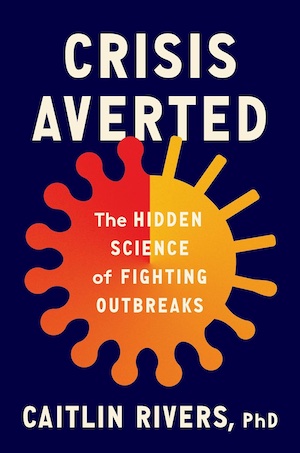
Caitlin Rivers, the author, presents an easy-to-follow narrative on the success of corralling cholera in London to wiping away the centuries-long smallpox pandemic. She is a public health professional but expands the focus of Crisis Averted to look at other threats to public health. For example, at one point, the nascent Weather Service in the U.S. refused to use the term tornado in weather forecasts to tamp down public panic. Eventually, this ostrich-like position was abandoned, perhaps in the aftermath of the Tri-State Tornado of 1925 in the Midwest. This storm featured 300 mph winds, a funnel up to one mile wide on the ground, and a path of destruction a couple hundred miles in length. After the fact, it would have been more protective to alert downstream citizens that a massive tornado was bearing down, and thus, all should seek secure shelter. Rivers makes the same case for our very recent brush with Covid-19. Had the nature of the pathogen been disseminated sooner, more lives could have been saved.
Rivers differentiates, via clear descriptions, public health challenges associated with pathogens old (smallpox, cholera, Black Death) and new (Ebola, Covid-19, SARS, mPox), and others waiting in the wings. For example, cholera has repeatedly devastated Haiti due largely to a chronic lack of clean potable water. Haiti’s cholera situation can be handled easily by adding a simple disinfectant to water before it is consumed. On-the-ground Haitian logistics have been, however, a stumbling block.
The book examines other public health situations that face similar huge roadblocks. For example, how do we ensure that no alien pathogens return to Earth from various space explorations? How do we avoid contaminating Mars during a visit? How do we prevent unintended outcomes related to releasing sterile male mosquitoes in the Florida Keys to suppress the frequency of various diseases? These challenges, and others, are considered and explained by Rivers in Crisis Averted.
Indeed, it is the breadth and depth of the book that add value to the clear narratives, which are a hallmark of the book. Success, failure, puzzlement, recurring outbreaks of certain diseases, and the constant war of bacterial and viral pathogens against humanity are the thrust of the book. The science of public health is the evolving, potent shield in these stories. Rivers presents a powerful case for public health supporting the health of the individual. The book is an excellent, timely, informative read. Dive in!
Robert Pellenbarg (ΦBK, George Washington University) is a research adjunct professor in the Department of Chemistry at California State University, San Bernardino. Prior to relocating to California, he conducted research for the Chemistry Division and the Ocean Sciences Division at the Naval Research Laboratory in Washington, D.C.