






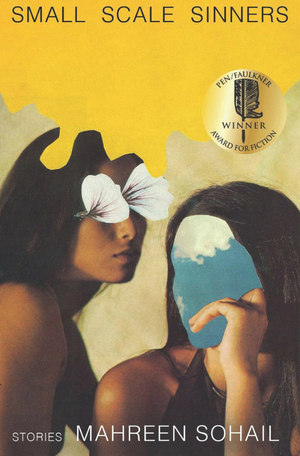
Unusually, when I first received Mahreen Sohail’s collection of short stories, Small Scale Sinners, I turned to the last paragraph. It was such a poignant wording of the immigrant experience, so beautifully written, I was moved to share it with others. A young friend who had just returned to Italy after her annual visit to her mother in the States became teary upon reading the passage. Such is the power of Sohail’s book, which won the 2026 PEN/Faulkner Award for Fiction. Yet while this last paragraph in the story “How to Raise American Children” might move you to tears as well, Sohail, who was born in Pakistan and has lived in the U.S. and England, is by no means a sentimental writer. Her vision is clear-eyed, even steely, in depicting the foibles and misguided attempts of humans to connect—or, more often, disconnect—in ordinary and extraordinary circumstances. Small Scale Sinners is about grief, separation, about bad decisions and small moments of compassion. It is about mothers and daughters, about neighbors and community, war and compromise. It is also about defiance—small acts of protest against a larger, indifferent universe.
We begin with “Our School Year,” an odd story told in the collective voice of schoolgirls fascinated by the arrival of twins to their class. We witness the girls’ initial crush on their new classmates, their measures to protect the twins from antagonistic teachers, and their slow, shared backlash against an act of brutal violence. Reminiscent of Alice Munro’s unsparing stories of the cruelties children are capable of, Sohail reports the incidents that unfold in “Our School Year” as though through a camera, seemingly uncritical yet revealing the horror of the complacency that leads to crimes going unpunished or unacknowledged. It is a chilling start.
The darkest story apart from the first takes place at a training camp for children, narrated by self-described “small scale sinners,” whose transgressions include: “like when the paramedics laid our mother out in the ambulance and instead of feeling scared we were annoyed.” Real crime is saved for the soldiers “training” these homeless children, using fire ants, for a perpetual war. Threaded through all of the stories is loss, as characters grapple with the pain of living alongside dying parents or the approaching surety of grief. Futile gestures are made again and again to assuage such pain, of which a narrator says, “I should not have to string these scenes up in front of you like this to help understand that the word loss has a weight that cannot be borne.”
Indeed, we expect our writers to explain the inexplicable, to frame our darkest acts, using words to illustrate our complicated human condition. One character tells us, “Nobody has taught me that living a life that is entirely your own is also an act of mourning.” And another says, “I promise I will be fine passing my time minute by minute, hour by hour like everyone else in this country.” What awaits the reader is an understanding of what propels us forward—the reasons, however elusive, for the awkward choices we sometimes make, the strength we gather to live yet another day.
Interestingly, as Sohail tells it, only the supernatural might offer some justice for the wronged. In one story, ghosts take revenge for women abused by the men in their lives—yet nothing is easy, not even for these ghosts, who ultimately need to seek forgiveness for their crimes against criminals.
And still awaiting you is that final story, about the separation of mother and child, that occurs repeatedly in so many of our lives. Here is some of that glorious last paragraph:
Stay for a while in the country that raised you. Go to her grave daily to meet yourself there, cajole yourself to come back to you. Finally, five weeks later, fly back to your husband and child and state, You are my life, like a declaration … ignore the ghost of your mother always sitting in a corner … laughing. Plead with her, I’m sorry, I’m sorry, I love you, until she leaves. Descend into sleep that is not sleep at night.
I urge you to read the rest of the paragraph. I urge you to read this breathtaking collection. It just might change your life.
Novelist Indira Ganesan (ΦBK, Vassar College) is the author of The Journey, Inheritance, and As Sweet as Honey, all published by Alfred A. Knopf, Inc.