






With such groundbreaking productions as Company, Follies, Sunday in the Park With George and Sweeney Todd: The Demon Barber of Fleet Street, the composer and lyricist Stephen Sondheim achieved a position of dominance in American musical theater. His musicals deal with unconventional themes—shattered dreams, pointillism and even cannibalism, to name a few—but they do so with a combination of wit, intricate rhyme schemes, and beautiful, if sometimes challenging, music that has beguiled audiences for more than half a century. His work has given rise to analyses, college courses, an encyclopedia, profiles, monographs, newsletters, books and even a discussion series, “Sondheim and the Torah,” at New York’s 92nd Street Y, showing how Jewish values have found their way into his work.
With all this erudition already available, is there a need for yet another book about this genius?
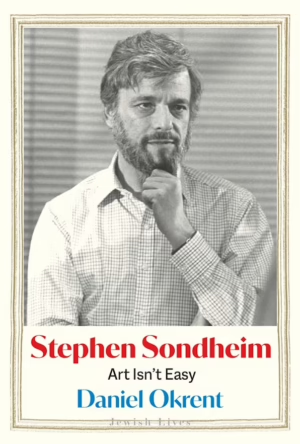
In the case of veteran author and editor Daniel Okrent’s Stephen Sondheim: Art Isn’t Easy, the answer is a resounding yes. (The subtitle, incidentally, is the title of a song in Sunday in the Park With George.)
The book, part of Yale University Press’s Jewish Lives series, not only includes exclusive quotes from scholars and those who knew Sondheim closely; it’s also the first major biography of the composer to reference an interview he gave to Columbia University’s Oral History Project in 1982, made publicly available only after his death in 2021.
The result is a compact, comprehensive volume that praises Sondheim’s versatility and brilliance and shows how he developed those traits. “He thought of himself as a composer first and a lyricist almost incidentally,” Okrent writes. “Yet he was awfully good at [writing lyrics], and he knew that the right words could enhance his music.”
And he was painstaking at it, Okrent writes, submitting 98 pages of notes and revisions for just one song (“Children Will Listen” from Into the Woods) to its orchestrator, Jonathan Tunick.
Okrent also traces how aspects of Sondheim’s personality found their way into his shows. Bobby, Company’s uncommitted main character who yearns to commit, is one example; another is George, the painter in Sunday, who puts his art above everything else, including the possibility of having a well-rounded life. And when Sondheim finally fell in love in his 60s, his thoughts on love’s power came to permeate Passion.
But this is an even-handed volume that also covers such topics as Sondheim’s alcoholism and drug use, his physical and emotional health, his homosexuality, his cutting wit and his tendency to go into years-long feuds. “Snark was his kingdom,” Jamie Bernstein, Leonard Bernstein’s daughter, told Okrent. But, she added, it was an honor to be welcomed into it.
Sondheim’s most difficult relationship, meanwhile, was with his mother, Etta Janet Fox “Foxy” Sondheim, who was shattered when her husband left her for another woman and turned her fury on her young son. In one letter, Sondheim quoted his mother as saying, “The only guilt I can think of is giving you birth.”
As a teenager, the fledgling musician found a valuable mentor in a neighbor, the Broadway lyricist Oscar Hammerstein II, who influenced Sondheim’s personal and professional life. “He said, ‘Write what you believe, and you’ll be 99% ahead of the game,’” Sondheim recalled. A second musical guide was Milton Babbitt, who showed Sondheim the basics of composition.
Sondheim knew how to network, and Okrent faithfully traces his career over the decades, showing how the composer wrote in a wide variety of genres, including vaudeville (Follies), operetta (A Little Night Music), Japanese music (Pacific Overtures), and even opera (Sweeney Todd). Okrent utilizes a fair amount of musicology to explain how Sondheim developed his shows and the characters who inhabit them, but the terminology never overwhelms.
Besides, there’s plenty of well-sourced backstage gossip and intrigue to keep readers turning the pages. Arguably the best of these anecdotes describes the creation of “Send in the Clowns,” Sondheim’s most popular song, for Night Music during its pre-Broadway tryout. A self-described procrastinator, Sondheim produced the deceptively simple song, cloaked in imagery and metaphor, that both advances the plot and expose the characters’ insecurities, overnight. He was proud of it, but he also regarded it as part of his job.
“Probably one of the most frightening things in the world is staring at a blank sheet of paper wondering how you’re going to fill it,” Sondheim once said. “But somehow you do.”
Reviewer John Pope (ΦBK, The University of Texas at Austin) is a contributing writer for The Times-Picayune | The New Orleans Advocate and served two terms on the Phi Beta Kappa Senate.