






Fred H. Lawson
Astute observers of international relations see many similarities between today’s world and the situation that existed in 1914. More than two powerful states compete with one another for strategic advantage and prestige; tight commercial and financial linkages ensure that economic fluctuations in one country will affect the stability and prosperity of others; alliances intended to preserve peace and security have become tenuous; and innovative weapons technologies threaten to make armed conflict more devastating while sharply reducing the amount of time that policymakers have to respond to complex and ambiguous dangers.
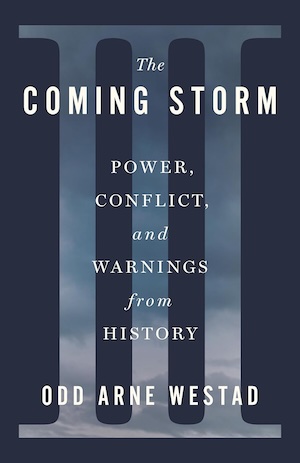
All of these trends reinforce the argument that the chances of large-scale war have become much greater now than they were during the turbulent but (in retrospect) manageable 1950s and 1960s. What Miles Kahler famously called “the 1914 analogy” has gained credence as an organizing framework for understanding the present and immediate future of world politics, and it provides the basis for Odd Arne Westad’s fluid and accessible analysis. The Coming Storm differs from earlier versions of the story by focusing on East Asia rather than Europe and by incorporating the rise of ethno-sectarian, populist movements as amplifiers of discontent and xenophobia across various geographical regions.
Like Paul W. Schroeder, Westad emphasizes the importance of the Austro-Hungarian Empire in generating the First World War. Actions taken by Vienna in July 1914 compelled Berlin to involve itself in what might otherwise have turned out to be just another passing crisis in the Balkans. At the same time, the alliance between Austria-Hungary and Germany proved insufficient to deter Russia and France from mobilizing their armed forces as tensions mounted that fateful summer. The failure of deterrence dragged Great Britain into the rapidly spiraling conflict, and a continent-wide conflagration ensued.
For the 1914 analogy to hold, some present-day state must be posited to occupy the vulnerable yet pivotal position in which Vienna found itself. Westad intimates that the current occupant is the Russian Federation, which currently plays junior partner to the People’s Republic of China (PRC) in the role of Wilhelmine Germany. Contemporary Russia may well exhibit the kind of rickety political structure that put the Austro-Hungarian monarchy in perpetual jeopardy, and the condition of Russia’s non-hydrocarbon economy is little better than that of the earlier Empire. Yet Moscow’s military establishment remains potent enough that Beijing feels no pressure to rush to the rescue. Consequently, the long-running war in Ukraine has not so far ensnared other participants.
At least part of what stops contemporary leaders from taking steps that might escalate local and regional conflicts into global wars lies in the existence of nuclear armaments. Whether the First World War would still have occurred if hydrogen bombs and intercontinental ballistic missiles had been invented at that time is, of course, unknowable. Westad mentions this notable difference between 1914 and 2026 in passing but largely neglects the impact of what Robert Jervis calls “the nuclear revolution” on world affairs. He may be right to do so: Jervis repeatedly warned that policymakers persist in behaving as if nuclear weapons were just like other explosives, only with bigger blasts.
Ignoring nuclear weapons permits Westad to lay out a number of “regions and issues [that] could play the same role today as Alsace-Lorraine, Bosnia, or Belgium did before 1914 as catalysts for [global] conflict.” One is Taiwan, where, he writes, any PRC invasion could provoke the United States to respond with “highly coordinated drone attacks, submarine torpedoes, anti-ship missiles, and long-range precision strikes to dramatically increase the cost to China of landing its forces” on the island. Another is the Himalayan borderlands between the PRC and India, where Beijing might well react to a clash between India and Pakistan with a “military response [consisting of] advancing well into the farther reaches of what China claims as its territory, focusing on strategic positions such as passes, ridges, and tactical heights.” Yet another is the South China Sea, where the Philippines and Vietnam are forging stronger alignments with Japan and India as a way to counteract PRC initiatives. The absence of any discussion of how nuclear weapons might affect the course of events in these arenas is striking.
Westad cannot be expected to have predicted developments after the manuscript was sent off to the publisher. It is nevertheless jarring to read that two “circumstances under which war is likely, or perhaps even desirable” are “to prevent the expansion of genocidal regimes, or even intervene against such regimes to protect the population living under their control.” Such thinking no doubt inspired the responses to events in Iran during January 2026 by policymakers in Jerusalem and Washington. Less prescient is the observation that “the U.S. global interventionism of the Cold War and the post-Cold War era has come to an end in the 2020s, especially with the reelection of President Trump in 2024.”
In fact, if the 1914 analogy actually holds, then rival great powers might well engage more frequently and energetically in overseas military activities in an attempt to secure an advantage over each other. Russia’s invasion of Ukraine, the PRC’s expansion into the South China Sea, and India’s “Act East policy” all reflect the shift from bipolarity to multipolarity. Odd Arne Westad’s closing recommendations to mitigate the effects of this structural transformation—make deterrence “believable,” demand personal meetings among leaders, encourage reciprocal respect among states, empower multilateral organizations, adjust to inevitable changes—appear woefully inadequate to the task at hand.
Fred H. Lawson (ΦBK, Indiana University) is Professor of Government Emeritus at Northeastern University, Oakland, California, and Adjunct Professor of International Relations at Universitas Brawijaya, Malang, Indonesia.