






By Suzanne Keen
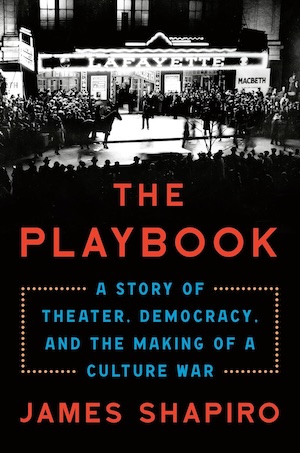
James Shapiro’s The Playbook is a deservedly celebrated book. It speaks to our contemporary moment with its unflinching account of the demise of a federally funded, nationwide, progressive theater program, the Federal Theatre Project, which was traduced as promoting un-American activities by Texas Congressman Martin Dies and the committee he founded. The Federal Theatre Project originated as an element of the Works Progress Administration, designed to employ out-of-work actors and showmen, tens of thousands of whom, alongside “playwrights, prop makers, musicians, prompters, stagehands, producers, ushers, designers, managers, carpenters, bill posters, advertising agents, scenic artists, electricians, dancers, and costume makers,” had been immiserated by the Great Depression. Rather than simply giving all these unemployed people handouts, the WPA program provided relief by engaging them in their craft to benefit fellow citizens.
As Shapiro tells the story, the program that his heroine Hallie Flanagan created, managed, defended, and ultimately failed to protect brought live stage performances to thirty million Americans, including urban children, immigrants, patients in asylums and hospitals, orphans, prisoners, veterans, rural people, and large radio audiences, as well as people in twenty-nine states. Two-thirds of its audience members had never seen a play before, and its thousand-plus productions ranged from Shakespeare to contemporary works about fair housing or the threat of fascism to a Broadway version of Pinocchio. It employed at its peak over twelve thousand theater people, including Arthur Miller and Orson Welles, but even President Roosevelt couldn’t save the program when it was abolished by Congress on June 30, 1939. It seems especially appropriate that among The Playbook’s many honors is the 2024 New Deal Book Award of the Living New Deal, a public nonprofit organization that carries forward the legacy of the New Deal, educates the public about the New Deal’s achievements, and keeps the New Deal alive as a model for public policy. In a stirring preface that makes certain his readers grasp that his story about the creation and dismantling of a short-lived program of a bygone era matters—in part because it reveals the unscrupulous but effective modus operandi of the enemies of progressivism—Shapiro celebrates Franklin Delano Roosevelt’s New Deal programs, seven of which still provide guardrails and guarantees to American citizens today.
Arguably, the Federal Theatre Project would have ended with the rest of the Works Progress Administration in 1943, when wartime jobs drove unemployment to historic lows, but it was brought to a premature closure in 1939, the first component of Federal Project Number One (which also included the Federal Art Project, the Federal Music Project, the Federal Writers Project, and the Historical Records Survey) to be defunded. Shapiro’s book explains not only what the Federal Theatre Project accomplished but also why it attracted negative attention from Congress and how Martin Dies’s successful attack on its alleged un-American activities provided the titular “playbook” for subsequent generations of opportunistic critics of liberal causes. Disturbed by the sight of African-American actors doing Shakespeare? Troubled by plays about housing discrimination or dramas springing straight from the pages of newspapers? Bothered by modern dance? Or simply affronted by any positive representation of a Roosevelt program or supporter? Just call it Communism and accuse the shows of harboring subversives and promoting radicalism. Done and dusted.
Similar tactics would be employed by J. Edgar Hoover and his cronies during the later period of the Hollywood Blacklist. Unsubstantiated ranting, misrepresentation of liberal ideas as Soviet propaganda, and smear tactics were demonstrated to be effective weapons in the culture wars. Anti-union, anti-Semitic, and anti-Communist critics cudgeled the Federal Theatre Project with sexual innuendos, allegations of free love and miscegenation, and mockery of the very titles of the plays the project had put on. That few, if any, of these enemies of the arts had even ever seen one of the productions was totally irrelevant. Martin Dies’s playbook may have originated with the idea of actually investigating subversion and gathering evidence of un-American activities, but it soon enough settled on the cheap and easy spectacle of congressional hearings, complete with testimony from plants and stooges.
Shapiro’s treatment of the rocky history of the Federal Theatre Project, told in five case studies of its productions, does not depict Hallie Flanagan’s accomplishments in an unmitigated rosy glow. He acknowledges blunders and failures, ill-judged compromises, cringe-worthy racism, lapses into formula, and box-office flops. Yet he argues passionately and persuasively for the ideal of an uncensored, unfettered, well-supported national theater—made up of touring companies and a network of regional playhouses—where American audiences could freely explore the ideas and issues that inform a liberated citizenry and build “a more equitable and resilient democracy.” If Hallie Flanagan’s creative legacy constitutes a positive playbook for pulling creative people together to the good of a pluralist society, it’s also vital to recognize the signs of Martin Dies’s playbook, still in use today.
Whether or not you think the federal government should be funding the arts with our tax dollars, the prevalence of content-policing, cancellation, and outright censorship of theater warns us of a growing threat to the essential human freedom of speech and expression that Franklin Delano Roosevelt gave pride of place in his 1941 State of the Union Address. It was two years too late for the Federal Theatre Project when Roosevelt imagined a future suffused by Four Freedoms, a world characterized by equality of opportunity, jobs for those who can work, social security for the needy, the end of special privilege for the few, the preservation of civil liberties for all, and the enjoyment of the fruits of scientific progress in a wider and constantly rising standard of living. The culture war launched by Martin Dies against what he saw as un-American activities was fueled by hostility to those ideals.
Suzanne Keen (ΦBK, Brown University) is Professor of English at Scripps College. She works on the novel and narrative empathy, most recently in Empathy and Reading: Affect, Impact, and the Co-Creating Reader (Routledge 2022).