






Shortlisted for ΦBK’s 2025 Award in Science
Long before the advent of modern neuroscience, philosophers and theologians alike wrestled with the nature of the mind, and few questions have proved more enduring than those of existence. Who are we, why are we conscious, and what purpose does our consciousness serve? What does it mean to be?
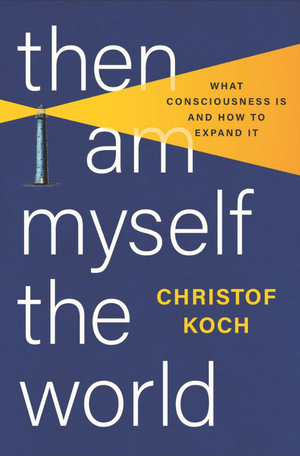
Christof Koch, one of the pioneers of consciousness studies, offers a fresh perspective in his sixth and latest book, Then I Am Myself the World. Borrowing its title from a translation of Richard Wagner’s mystical Tristan und Isolde, this book is part neuroscience primer, part philosophical meditation, part memoir of a decades-long career.
Koch, former president of the Allen Institute for Brain Science and a former professor at Caltech, opens Then I Am Myself the World with the single proposition he considers indisputable: Subjective experience is real. We need only to reflect on our own inner lives to appreciate this. After all, how else might you describe the color green to someone born blind?
Yet Koch does not ask the reader to simply accept this axiom on faith. Instead, he examines evidence such as the ways sleep modulates our conscious states, the ongoing debates over fetal consciousness and brain death, and the phenomenology of religious and mystical experiences. Along the way, Koch reexamines decades’ worth of discoveries in neurobiology, building a case that consciousness is a genuine phenomenon worthy of scientific inquiry.
The result is an impressively accessible tour through a weighty topic, Koch balancing technical detail against more intuitive examples well enough to keep nonspecialists engaged.
This steady march of scientific progress eventually arrives, however, at an imposing chasm. Despite all that neuroscience has revealed, the mechanisms that actually give rise to subjective experience still elude us. Koch terms this conceptual impasse the “explanatory gap,” and it is here that he introduces the framework of consciousness at the heart of the book: integrated information theory (IIT).
Beginning in the 1990s, Koch collaborated with Francis Crick, famed co-discoverer of the structure of DNA, to jumpstart the search for the “neural correlates of consciousness”—the specific patterns of brain activity associated with conscious experience. Their work helped to lay the empirical foundation for IIT, which, perhaps unsurprisingly, resists easy summary. At its core lies a proposed mathematical quantity (Φ or phi) intended to measure the degree to which information within a system, such as the brain of a living organism, is internally “integrated.” Precisely what Φ represents, and how it pertains to conscious experience, remains somewhat difficult to fully understand even after a chapter’s worth of explanation.
Still, Koch tries his best to translate IIT’s mathematics into digestible prose. Conscious experience, he explains, is both highly differentiated—our experiences are unique relative to the enormous number of possible experiences—and irreducibly unified. Rather than beginning with neurons and asking how consciousness directly emerges from them, Koch works backwards by “start[ing] with consciousness” and asking what physical properties a system must possess to support conscious experience. This is a valiant effort, but it is still difficult to conceive of consciousness existing independent of a brain.
Indeed, IIT has its share of critics. Some have likened it to string theory, arguing that it cannot be properly called science because many of its central claims are effectively unfalsifiable. Others have argued that IIT’s quantitative approach merely masks the same absence of empiricism that has characterized previous theories of consciousness. To Koch’s credit, however, he neither dismisses IIT’s critics nor dwells on them for long. The book rarely reads as a manifesto for IIT so much as an invitation to take one of its boldest hypotheses seriously: that consciousness is not exclusive to the human brain or even the brains of living organisms but is an intrinsic property of any physical system that is sufficiently “integrated.”
Further chapters broaden the discussion beyond IIT, from spirituality and consciousness after death to the timely question of AI consciousness. Even readers unconvinced by Koch’s theorizing will likely find value in these chapters, each informed not only by Koch’s decades at the forefront of his field but also by his wide-ranging knowledge of theology and history, as well as a gift for telling memorable anecdotes.
Then I Am Myself the World does not pretend to offer the final word on consciousness. Instead, Koch succeeds in convincing the reader of something more valuable: that one of humanity’s oldest philosophical predicaments has become one of science’s most fascinating frontiers.
Alexander Jungxiang Chen (ΦBK, Harvard University) is pursuing an M.D. at the University of California San Francisco School of Medicine.