






By Andrea K. Dobson
Civics and engineering aren’t just about what we choose to do; they are about what we choose to become.”
—Guru Madhavan.
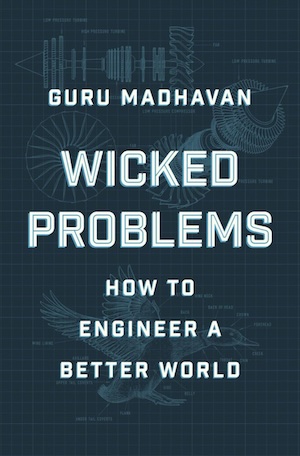
In Wicked Problems: How to Engineer a Better World, Guru Madhavan, senior director of programs at the National Academy of Engineering, makes the case that progress on life’s most “pernicious problems,” e.g., climate change, pandemic response, or nuclear disasters, requires a systems engineering approach—one that is multifaceted, civic-minded, and inclusive of the diverse perspectives of a range of constituencies.
The type of questions many of us imagine when we think of engineering are those Madhavan calls “hard”: bounded problems with solutions to be found using the tools of mathematics, scientific principles, or market pressure. “Soft” problems involve human behavior and vary by context—one of Madhavan’s examples is traffic congestion: there are a range of reasons for congestion and a range of ways to address it; what works in one city may not work in another. “Messy” problems arise when values and beliefs clash. The truly “wicked problems” involve all three. Madhavan, whose background is in biomedical engineering, uses a disease outbreak as an illustration. Tracking medical supplies is a hard problem; mapping the spread of the disease is a soft problem. In several of the African communities experiencing Ebola, these problems intersected with religious burial practices. Addressing the disease outbreak required cultural sensitivity in addition to technological solutions.
Madhavan argues that tackling such wicked problems requires a “communal code of conduct—or, in an engineering sense, a concept of operations”—informed by six attributes: efficiency, vagueness, vulnerability, safety, maintenance, and resilience. Each of these core dimensions of systems engineering serves as the theme for a chapter, illustrated with a broad range of examples. Consider, for instance, vagueness: How much of a thing is enough? In the sorites, or heap, paradox attributed to the 4th-century BCE philosopher Eubulides, one grain of sand is not a heap. Neither are two grains: adding one grain of sand does not create a heap. But 100,000 grains of sand has become a heap. Where do we make the shift from individual grains to a heap? This becomes a modern-day problem when air travel collides, literally, with the ash from volcanic eruptions. As Madhavan points out, for “an aircraft operating at 600 miles per hour, volcanic ash is mechanically, electrically, and chemically asphyxiating.” But how much ash requires closing the airspace around an erupting volcano? There is no precise answer, but rather a “messy vagueness” that demands input from jet engine manufacturers, insurers, regulators, and the travel industry.
Many examples—some tragic, some success stories—serve to convey the points in these six chapters. How best to tackle homelessness among veterans? How to maintain a city’s wastewater treatment infrastructure, especially one that incorporates elements from multiple centuries? What can we learn from the damage done by Hurricane Katrina or the nuclear meltdown at Three Mile Island?
Woven through the chapters on systems engineering are a series of vignettes from the life of engineer Ed Link (1904–1981), creator of the Link Trainer, designed to teach pilots to rely on their instruments when they flew, not just on their eyes. The early days of aviation were dangerous, especially in bad weather. Link, who learned to fly in the early 1920s and whose family manufactured automated pianos and organs, realized that he could combine the cockpit and controls of an aircraft with pneumatic technology from the organ factory to create a simulator that would allow new pilots to experience the motion and instrument readings of an airplane before taking to the skies. It was a hard sell initially, seen more as a novelty; eventually, his invention became an essential element of training for pilots and, later, astronauts. Engineering solutions can be both technically ingenious and socially transformative.
Wicked Problems is not merely descriptive. Madhavan calls for engineering education programs to embrace civic considerations: engineering has ethical, environmental, and social consequences. That isn’t new: archaeology of Bronze Age sites of the Indus Valley Civilization has revealed a highly sophisticated level of “food production, . . . town planning, drains, dams, and dockyards” that demonstrated not merely technological capacity but also a high level of civic engineering. If we so choose, we can prepare engineers not merely to build better stuff but to build better societies.
Wicked Problems does not provide easy solutions to the challenges facing us today. It does celebrate the intersection of technical ingenuity, ethics, and collaboration and reminds us that to engineer is human.
Andrea K. Dobson (ΦΒΚ Whitman College) is Chair of the Astronomy Department at Whitman College.