






By Andrea K. Dobson
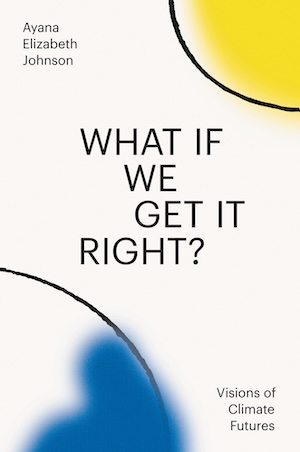
“What if we live as though we love the future?”Marine biologist and conservation policy strategist Ayana Elizabeth Johnson asks us to imagine a world in which we act in community, using our collective wisdom to propel ourselves out of our protracted procrastination, to “live as though we understand this [climate] crisis is real.” Although there is no single magic bullet, Johnson argues that we do have many tools: we have the capacity to mend the earth, clean the air and water, act with climate justice, and create a world that will continue to be habitable. And to do so is imperative: as one section is titled, “there is nothing naïve about moral clarity.” It is simply wrong to make our “magnificent planet unlivable.”
What If We Get It Right? is a collection of conversations with people who have expertise in various pieces of the puzzle, including regenerative farmers, environmental activists, design architects, visual artists and video producers, and specialists in clean energy, Indigenous rights, ocean policy, and artificial intelligence, as well as those who focus on how to prepare for climate disasters. Art and poetry are interspersed among nearly two dozen interviews and essays, some scary, many inspiring. Each section begins with ten problems balanced with ten possibilities, most being actions that we could, individually or collectively, take to reduce environmental destruction. Each conversation ends with Johnson asking, “What do we need to do?” and “What are the top three things you wish everyone knew?” about climate change, climate justice, and solutions that we could put in place today. The data are here, too, but rather than focusing on what we have done wrong, Johnson’s emphasis is on effective solutions that could take us to a future in which life thrives.
Several examples involve positive ways to use nature and traditional Indigenous practices. One such opportunity is regenerative ocean farming of kelp and other seaweeds alongside bivalves such as oysters or mussels. Cultivating kelp and oysters together leads to higher yields of kelp and lowers water acidification, which helps the oysters’ shells grow. The process produces edible protein and jobs while sequestering carbon and cleaning the ocean water.
Other examples focus on climate justice. We don’t have to continue to live in a system “where your zip code and the color of your skin” determine whether you have access to fresh food or whether your neighborhood is where the next highly polluting industrial plant will be located. Johnson, who learned about design and construction at an early age from her architect father and about homestead farming from her mother, a retired English teacher, asks what it would be like “to live not on top of nature, but within it.” Why not rebuild the dunes and vegetation that have long protected our coastal communities from the worst ravages of storms, especially as those storms are now more damaging due to warming ocean waters?
Throughout What If…? Johnson and her collaborators emphasize the need to rebuild a sense of community and democracy, to let everyone know that they are valued and to inform our elected leaders that they need to act in the best interests of their constituents. There are sections some readers may find disheartening: What If…? was published in 2024, at a time when Johnson and the book’s contributors could point to some progressive national projects that were subsequently reduced or eliminated in 2025. Still, there are many possibilities here for anyone who cares about the future of the planet and has been seeking a vision of what a better future might look like and how to contribute to creating it. As Johnson says, it is not too late to be “tenacious on behalf of life on Earth.”
Andrea K. Dobson (ΦΒΚ, Whitman College) is Chair of the Astronomy Department at Whitman College.