






By Alexander Junxiang Chen
“In 1492, Columbus sailed the ocean blue.” So goes the familiar grade school rhyme that taught many of us a tidy story: there once existed a pristine and static American continent, but then came Europeans across their Ocean Sea with guns, germs, and steel. Before long, the natives were no more.
For decades, history textbooks broadly agreed in how they staged the tragedy of Indigenous America. Yes, the Maya and Aztecs, Inca and Iroquois, they all existed once, but only in some distant era, characters written solely to be killed off in the first act. There is a reason, after all, that one of the most circulated “Did you know?” facts on the internet notes that the University of Oxford (est. 1096 CE) predates the Aztec Empire (est. 1300 CE). The implication is not subtle: Native civilizations belong to prehistory, an era that ended upon the arrival of the Santa Maria, Niña, and Pinta.
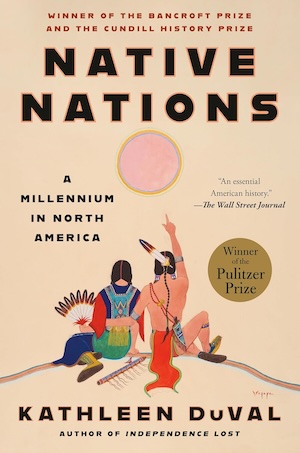
In Native Nations: A Millennium in North America, Kathleen DuVal, a professor of history at the University of North Carolina, Chapel Hill, seeks to dismantle this popular narrative. Her central claim is straightforward: Native nations were never a prologue to American history, but rather active political actors up until the industrial age. From the woodlands along the Great Lakes to the river canyons of the Southwest, Indigenous peoples reacted to European contact in a myriad of ways. Some chose to fight. Others forged economic or diplomatic relationships, sometimes voluntarily, sometimes under duress. Many did both. What none did, DuVal insists, was simply vanish.
Coexistence rather than conquest was the defining condition of early colonial America, argues DuVal. For at least the first three centuries following European arrival, a period of time longer than the United States has existed, colonists remained a numerical minority on the continent. Their fragile settlements persisted alongside a dense and shifting patchwork of Native polities, each with its own internal politics, ambitions, and stratagems.
DuVal’s arguments rest on her adept command of a wide range of historical sources. Skeptical of the popular “disease thesis,” the idea that smallpox, measles, and other Old World germs killed off nine out of every ten Natives within decades of contact, she notes that archaeological evidence has never corroborated such uniform demographic collapse. Disease mattered, but its effects were uneven and usually mediated by social and political context.
Other opportunities for perspective-taking abound. To dispel the common perception that Indigenous polities never built cities of European size or complexity, DuVal reminds readers that Cahokia, the largest pre-Columbian city north of Mexico, rivaled medieval London in scale. To counter the equally persistent notion that Indigenous societies unfolded on a different historical timeline, she notes that Cahokia peaked in the same decade William the Conqueror triumphed at Hastings. Indigenous societies, DuVal shows, were no more timeless or ahistorical than their Afro-Eurasian counterparts.
There is also little hint of partisanship in DuVal’s prose. An equal-opportunity critic, she skewers revisionist accounts that treat Native experiences solely in terms of victimization and decline just as sharply as the antiquated narratives that portray them as categorically oppressed “noble savages.” Her subjects are neither saints nor symbols. They are communities and cultures to whom DuVal restores historical agency long denied.
DuVal’s choices in verbiage are also telling. Wherever possible, she refers to Native nations by the names they used for themselves. Familiar terms such as Iroquois and Creek give way to Haudenosaunee and Muscogee, respectively. The choice is not simply cosmetic.
At more than seven hundred pages, Native Nations is not a light read. Nor is it strictly linear, as DuVal often returns to the same regions across multiple centuries to trace the evolving stories of more than a dozen Indigenous polities. Yet this repetition is its point. Native nations remained central to American history for centuries after Columbus, not as background figures, but as vibrant political communities. Accordingly, this is not a book about Montezuma and the Aztecs, nor about Powhatan, Squanto, or the handful of familiar figures who dominate the narrow slivers of Indigenous history taught in schools. Countless other Native cultures and civilizations, often smaller in size, were integral to the pre-Columbian historical fabric, with their own complex economies, urban settlements, and political machinations. DuVal places them where they have long belonged: at the center of the story.
DuVal is not the first historian to reframe Native history through a Native lens. In 2022, Pekka Hämäläinen, professor of American history at Oxford, offered a similarly ambitious account of Indigenous power and persistence. What distinguishes DuVal’s contributions from earlier surveys, however, is her refusal to frame Indigenous political authority primarily as a response to European encroachment. Whereas Hämäläinen emphasizes prolonged contests over power between Indigenous nations and European empires, DuVal treats Indigenous political authority as a historical constant rather than a contingent response to colonization.
This difference does come at a cost. By treating Native sovereignty as a starting point rather than a claim to be argued for, DuVal sometimes leaves questions of hierarchy and coercion unanswered. Readers drawn to a more sustained, dialectical framing of Native-colonizer relations may therefore find Native Nations more descriptive than explanatory in places.
Even so, DuVal’s approach is deliberate. She writes as though Native nations were the norm rather than the exception. They existed before, during, and after colonization. In doing so, she asks the reader to consider a more unsettling possibility: that it is the narrative of disappearance, not Native persistence, that has been the historical fiction all along.
ΦBK member Alexander Junxiang Chen recently graduated from Harvard University with a bachelor’s in Neuroscience and Chemistry, and a secondary emphasis in Global Health and Health Policy. He is pursuing an M.D. at the University of California San Francisco School of Medicine.