






Winner of the 2026 Ralph Waldo Emerson Award
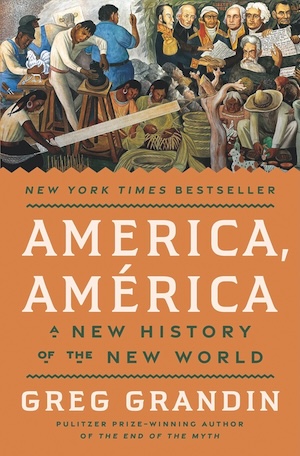
Exceptionalism lies at the heart of the national myth of the United States of America. Since the country is not like any other, its history has always been considered unique as well. Only recently have efforts been undertaken to situate the development of the United States in a broader context, either by comparing its trajectory to those of other countries or by placing it in a more comprehensive analytical category, most notably as an instance of empire.
Greg Grandin sets out to shatter the notion of United States exceptionalism by incorporating its past into a larger geographical framework—the Western Hemisphere as a whole. The project demands that the story begin considerably earlier than usual, with the coming of Spanish explorers, conquistadors, and missionaries a century before Jamestown. Even sympathetic readers may grow impatient with the opening 66 pages, which detail various perspectives on the Spanish conquests by contemporaneous Spanish writers. None of their treatises addresses the lands north of Mexico City, not even Florida.
In a similar vein, when the English arrive, they take no notice of Spanish America. So it is not until Chapter 8 that the two realms start to overlap. Here, Grandin shows that the English campaign to subdue the Irish bears a striking resemblance to Spanish military operations in Mexico and Peru. The English, in fact, based their tactics on reports coming from the New World. More importantly, the doctrines that English lawyers formulated to justify the conquest and plunder of Ireland can be traced to arguments propounded by Spanish legal scholars. John Locke appears to have appropriated concepts advanced by the late sixteenth-century philosopher José de Acosta—sometimes word for word.
Beginning with the “American Revolution,” that is, the uprising of the English colonies in North America during the 1770s, America, América recounts overlooked aspects of military, political, and cultural relations between the United States and the countries of Spanish America. The role of Spanish forces in the struggle for United States independence, for instance, had a greater impact than people outside Mobile and Pensacola recognize.
The crucial question, however, is to what extent the book alters the way we comprehend the interlocked histories of the United States, Mexico, Peru, Brazil, and the Caribbean—not to mention Canada. Grandin’s survey of the revolutionary movements led by Simón Bolívar looks pretty conventional to a non-specialist. It is juxtaposed against the deliberations of James Monroe and John Quincy Adams about how the United States might manage its dealings with the nascent polities to the south. The two accounts barely converge, although courses in “American history” that ignore the former will probably benefit from having them presented together.
Occasionally, the promise of the intellectual project breaks through the side-by-side narratives. Chapter 23, for instance, revises our understanding of the burst of cultural energy that Ralph Waldo Emerson called “the American Renaissance.” Grandin demonstrates that the ideas and initiatives that constituted this movement also permeated Spanish America. Trends in Chile proved remarkably similar to those in the United States and conjure up comparisons for graduate students to pursue and readers to ponder.
America, América goes on to deal with United States imperialism at the close of the nineteenth century; the Mexican Revolution that erupted in 1910; United States interventionism in the Caribbean between the First and Second World Wars; political unrest and upheaval in South America after the Second World War; and the emergence of radical currents in Guatemala, Nicaragua, and Cuba. The accounts become more cursory as the pages go by, and the book ends with a disquisition on the impact of Washington’s severance of ties with the Western Hemisphere during the 1960s. “Going global,” Grandin asserts, “shaking off Latin America as a restraint and returning the region to the status of an informal dependency—had the effect of unleashing Washington’s worst policy instincts.” Costly embroilments in Vietnam, Afghanistan, and Iraq ensued.
What remain elusive are the novel insights that can be obtained from amalgamating the histories of the seemingly disparate communities that inhabit the New World. Telling their respective stories alongside each other marks only the preliminary step toward fashioning a grand synthesis.
Fred H. Lawson (ΦBK, Indiana University) is Professor of Government Emeritus of Northeastern University, Oakland, California, and Adjunct Professor of International Relations, Brawijaya University, Malang, Indonesia.