






By Robert Pellenbarg
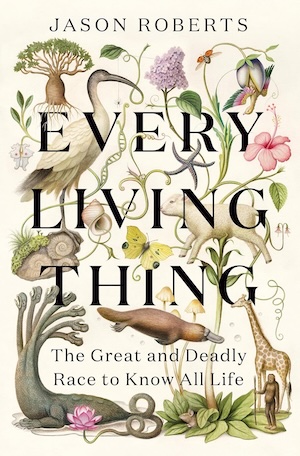
Most readers will notice that often, in the literature, references to biological entities include two terms. For example, our faithful companions, the domestic dog, are labeled Canis familiaris. On the other hand, the grey wolf is listed as Canis lupus. From a botanical perspective, note that the red oak is Quercus rubra. And examine the following tongue-twister: Ornithorhynchus anatis, commonly known as the duck-billed platypus. So, what is the origin of this nomenclature system? Jason Roberts leads the reader of Every Living Thing on a fascinating exploration of this topic, focusing on actions in the mid-1700s by two towering figures in developing science, which led to botany, biology, ecology, and myriad other high-order endeavors.
Carl Linnaeus was born in rural Sweden. His father held a minor government position as collector of the “salt (sodium chloride) tax.” His portion of the “tax” enabled Carl to receive a meager education and gain entry into positions that dealt with collecting and cataloging collections of natural materials, especially plants. As collections grew, it became clear to him that naming the items in the collections would be of utility. Thus, Linnaeus began naming plant specimens and placing specimens that looked similar into groups. He produced several increasingly massive editions of his well-regarded Systema Naturae over the years, outlining a how-to process for organizing biological chaos. Throughout, he hewed to the conventional wisdom of the 1700s regarding the age of the Earth, the origin of individual plants, and their immutability.
In contrast to Linnaeus’s positions, a contemporary by the name of Georges-Louis de Buffon, born in France, worked on similar topics from a radically different perspective. Buffon emphasized careful observation to yield facts related to biological specimens, fossils, geological processes on the Earth, and their interactions. He wrote extensively and speculated on ecology, human activities damaging the Earth, extinction in biology, and many other topics. Note, of course, that formal disciplines in branches of science, even the concept of “scientist,” did not exist in Buffon’s day. In short, Buffon was ahead of his time and was careful in his writings to avoid challenging the conventional wisdom, e.g., the age of the Earth. Nonetheless, Buffon did produce several notable contributions to technology outside of the biological sciences. Buffon’s Needle is still used in the statistical sciences, and later in his life, he established an iron foundry that made significant contributions to the technology of cast iron.
Jason Roberts explores the above men and their endeavors, interactions, quarrels, agreements, and legacies in great detail. The trail of history Roberts marks is clear, detailed, informative, and easy to follow. Linnaeus, while sincere, was a blatant self-promoter, often submitting glowing but anonymous reports of his writings for publication. He was pleased when, through political maneuvers, he was able to add the term “von” to his name, elevating his social status. Buffon, on the other hand, was much more behind-the-scenes, very content to ask others to let the facts speak for themselves. Indeed, Buffon, widely lionized in France for his acumen, was able to avoid the worst of the French Revolution by maintaining a low profile.
Every Living Thing will reward the student of history, especially the history of science, with much detail and perspective. The role of politics in said history is well documented and fascinating to read and ponder. The situation of the book is best summed up by Buffon’s famous quote: “The true and only science is the knowledge of facts.” Read, learn, and enjoy a wonderful excursion of discovery.
Robert Pellenbarg (ΦBK, George Washington University) is a research adjunct professor in the Department of Chemistry at California State University, San Bernardino. Prior to relocating to California, he conducted research for the Chemistry Division and the Ocean Sciences Division at the Naval Research Laboratory in Washington, D.C.