






By John Pope
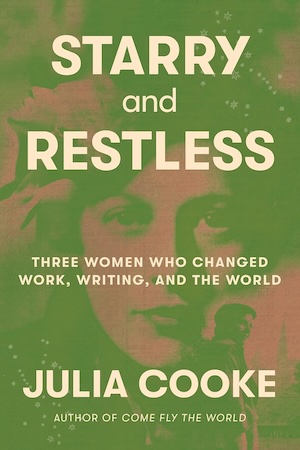
The three women whom Julia Cooke profiles in her book came from vastly different backgrounds in the United States and England, but they harbored the same passion: They wanted to do journalism that mattered instead of what they saw as the role that the profession offered women in the first third of the 20th century: a dreary, mind-numbing round of stories about recipes, homemaking tips, the latest fashions, and debutante cotillions.
Martha Gellhorn, one of the book’s subjects, told a friend why she felt she had to cover the Spanish Civil War in the late 1930s, even though women reporters were outnumbered and editors were reluctant to send women into combat:
“It is just something I have to do. It’s in my blood.”
Similar rationales came from Rebecca West and Emily “Mickey” Hahn, the other two globetrotting journalists who are the subjects of Starry and Restless: Three Women Who Changed Work, Writing, and the World.
Off they went. West covered ravaged Yugoslavia. Hahn trekked to Africa, Shanghai, and Hong Kong in the years leading up to World War II. After writing about the Spanish Civil War, Gellhorn set her sights on Europe and wound up going ashore in Normandy after the Allied invasion on D-Day.
Most of their work appeared in magazines such as The New Yorker, Collier’s and The Saturday Evening Post. Working in this format not only spared them from having to jostle for precious press credentials with newspaper reporters working on deadline but also gave them time and space to develop underlying themes, such as the impact of war on everyday life and the inherent drama in hospitals and aboard troop ships.
“Often limited by regulations that kept women from equal access to war fronts and official briefings, they peered into corners and pulled up rugs and found different stories,” Cooke writes.
Their tales were often amazing, and Cooke is a master at telling how they landed their stories. Hahn insinuated herself into—and wrote about—opium-fueled Shanghai society, taking a lover in the process, and West took pains to show what she called “what happens after the great moments in history to the women associated by natural ties to the actors.”
The book is strongest when it relates Gellhorn’s feats. She described the bombed-out streets of what had been a fashionable section of Madrid, and she reported graphically on the horrors of Dachau. At that death camp, Cooke said, Gellhorn wrote about an inmate who had survived by hiding beneath corpses: “Four weeks and he would be a young man again, said the Polish doctor, who had also been a prisoner for five years. ‘One cannot believe that his eyes will ever be like other people’s eyes,’ Martha wrote.”
The best anecdote in the book involves Gellhorn and Ernest Hemingway, her hyper-competitive husband, who decided he wanted to cover the Allied invasion for Collier’s and snapped up the only press pass that the magazine would provide.
Gellhorn was furious but resourceful, sailing to Europe on a freighter and, once in England, talking her way aboard a Red Cross hospital ship and locking herself in a latrine until the ship approached Omaha Beach. Although the landing had already happened, Gellhorn stayed busy—interviewing, observing and, finally, wading ashore—before returning to London to write.
Hemingway never made it to shore.
In relating these stories, Cooke skillfully cross-cuts from one woman’s narrative to another, ending each chapter with a cliffhanger. She also toggles back and forth from the tales of her three protagonists to the bigger picture, showing the small, incremental increases of women covering the war and taking pains to point out that there had been other women covering international news: The columnist Dorothy Thompson, for instance, had been kicked out of Germany because Adolf Hitler didn’t like the way his interview with her had turned out, and Anne O’Hare McCormick of The New York Times had become the first woman to win a Pulitzer Prize for international reporting.
Unfortunately, after building up an impressive head of steam, the book’s momentum starts to drag after World War II. While nothing could match the impact of war, the postwar section evolves into page after page of travel arrangements and domestic disputes, followed by an overlong summary about the evolution of women in journalism.
But that shortcoming should not diminish the impact of what the book does in showcasing what these women accomplished. In addition to her wartime feats, Gellhorn also wrote fiction, and Hahn wrote a biography of the three powerful Soong sisters, one of whom had married Chiang Kai-shek and another of whom had married Sun Yat-sen, who founded the Republic of China. And West covered the trials of Nazi leaders and sympathizers, resulting in a book, “The Meaning of Treason,” that made The New York Times reviewer comment that “she writes with such force as to make most male writers appear effeminate.”
Reviewer John Pope (ΦBK, The University of Texas at Austin) is a contributing writer for The Times-Picayune | The New Orleans Advocate and served two terms on the Phi Beta Kappa Senate.